Showing posts with label Books. Show all posts

Saturday, October 18, 2014

Review: Sea of Death

(Caution: Spoilers)

No, I haven't forgotten my reviews of various Greyhawk novels. When last we left, I had just reviewed Artifact of Evil, the second in Gary Gygax's "Gord the Rogue" series of books, published right before he left TSR. Now we turn to the first in the series to be published after his departure (and the first to actually bear the "Gord the Rogue" banner as a series identifier), Sea of Death.

Published by New Infinities in 1987, this novel picks up some months after the previous installment, and finds Gord in the Baklunish lands west of the Flanaess. He is on a mission to recover the second part of the three-part artifact known as the Theorpart, which will free the god Tharizdun from his aeons-long sleep and bring about the final victory of Evil over the multiverse. To assist him in this mission, he has been endowed with magical powers by the Demiurge (Basiliv, who in Gygax's Greyhawk is the Mage of the Valley), and the Cat Lord, who favors the forces of Neutrality.

The second part of the artifact, known as the Second Key, is found in the City Out of Mind in the dangerous Sea of Dust. The map in the beginning of the book confirms that this is the same as the Forgotten City on the original Darlene map of the World of Greyhawk.

One of the things I like about this novel is that we see a lot of the inner workings of the various evil factions. Iuz finds himself under the thumb of his mother Iggwilv and his ally Zuggtmoy, while at the same time opposing his father Grazz't, who is in turn opposed by various other princes of the Abyss. They, being chaotic, oppose the release of Tharizdun, but wish the power of the various keys that will free him for themselves. Against all of these chaotic evil factions is Anthraxus, leader of the neutral evil plane of Hades, who is working to see Tharizdun released, feeling he will be given a high place in the new order of evil. It's clear in these passages that Iuz is a favorite character of Gygax's, and he gives some wonderful dialogue to the cambion.

And opposing all those still are the forces of Neutrality (of which Gord is a highly-placed champion), and we get some inkling that Good is also involved, but appearances by angels and solars are few.

Iuz and Grazz't are contesting for the Second Key by sending a single agent with some assistants; the evil dwarf Obmi (from the previous book, as well as appearances in Hall of the Fire Giant King and the original Castle Greyhawk) on behalf of Iuz/Iggwilv/Zuggtmoy, and the drow priestess Eclavdra (also from Hall of the Fire Giant King, as well as Vault of the Drow) on behalf of Grazz't. To befuddle their enemies, Grazz't and his right-hand-demon Vuron (one of the most fascinating characters in the series; more about him later) have created a clone of Eclavdra, who will act as a decoy.

Of course, things don't go according to anyone's plan. The clone of Eclavdra survives, although she doesn't remember being Eclavdra, and is known as Leeda, Gord's love interest. They proceed to the buried city with trusted Baklunish tribesmen, and all three groups converge on the resting place of the artifact at the same time (which is actually lampshaded in the book, with one of the characters saying something about such synchronicities being arranged by mysterious forces).

In the city, they encounter albino pygmies, the degenerate descendants of the Suel who did not flee the city when calamity struck down the Suel Imperium centuries earlier, who are served by vicious albino apes. They have many captives from the surface, and we learn that there is some trade between the underworld of the drow and this place; Leda's memories slowly resurface as she continues on with Gord (and her character becomes more like that of the true Eclavdra).

Eventually, Gord prevails over the perils of the city, and a cadre of slaves is rescued. The desert is once again crossed, and on the shores of Jerlea Bay a huge battle is fought not only between the three agents, but also the extra-planar assistance they invoke. Leda slays Eclavdra, the forces of Good intervene, and eventually the magical powers involved hurl most of the combatants into other planes.

At the very end, Vuron convinces Gord to hand over the Second Key to him, along with Leeda, who will serve in the role of Eclavdra, to temper the actions of his lord, Grazz't. This is an instance of the odd nature of Vuron, who is as alabaster-white as his master is ebon-black, and who displays a decidedly lawful streak for a demon lord. He might even be said to suffer from pangs of Good, and the scenes were he puts his intellect on display are wonderfully done.

From a gaming standpoint, there is a ton of material that could be used in a campaign. Details large and small abound about the Baklunish tribes north of the Sea of Dust, there are enough pieces of information about the flora and fauna. weather, and environment of the Sea itself to run an adventure or three within it, and tantalizing hints about some of the lands west and south as well (some nations are named, which I used in my own "Beyond the Flanaess" maps several years ago). The City Out of Mind/Forgotten City is described in relative detail; certainly enough that an enterprising DM could use the chapters set there as the basis for a fully fleshed-out adventure.

This is the point in the series where Gord becomes more of a Mary Sue, however. Imbued with magical powers by various powerful beings, this novel sets him on the road to near-unstoppability, and the resultant increase of the power level of his enemies means that his companions (Curley Greenleaf, Gellor, and Chert) become more sidelined. Personally, I find that hurts the stories themselves, and therefore I give this novel three wizards out of five. Still recommended, especially if you're looking for a source of inspiration and information on the places visited, but not required reading.

Tuesday, August 5, 2014

Review: Artifact of Evil

(Caution: Spoilers)

Hot on the heels of my review of Gary Gygax's first novel, Saga of Old City, we come to the second in the series (and the last published by TSR), Artifact of Evil, published in 1986.

This book has a very different feel than its predecessor, even though the action takes place only a few months after the end of the first. Where Saga of Old City was episodic, with no real plot threading throughout it other than chronicling Gord's early adventures, Artifact of Evil has a definite plot. The forces of Evil are searching for a powerful artifact that can be used to loose the evil god Tharizdun from his prison, thus bringing doom to the world unless they can be stopped.

The novel begins in media res with a siege and battle of a Scarlet Brotherhood-controlled stronghold in the Pomarj, Castle Strandkeep. It's fascinating to see Gygax's version of what a mass battle would look like in a D&D world; there's even a justification for the creation of all those dungeons underneath castles (to make it much more difficult for sappers to undermine castles during sieges; imagine tunneling into a warren of trolls or ogres).

The action doesn't let up as the forces of Good (or, at least, Balance) launch their own expedition to recover the Second Key. The book is then a chase, as the evil Obmi, one of the servants of Iuz, gains the Key and heads northwards to deliver the prize. There's a lot of interesting tactics, and although some of the traitor/spies were telegraphed pretty early, it didn't lessen the story. We see some familiar places like Hommlet, and the Temple of Elemental Evil gets a cameo as Zuggtmoy is freed in a way very different from how that pivotal event happened in Gygax's home campaign. (Which in and of itself raises the question; which is the canonical version of the story? Both have been referenced in official TSR products.)

The new characters, like Deirdre and Oscar of Hardby, were used to good effect to illustrate the female-dominated mores of that place, but the stand-out characters are the villainous Obmi and his insane elf minion, Keak.

Long-time fans of Greyhawk will recognize Obmi as the dwarf in the original Greyhawk campaign on one of the upper levels who controlled a magical device that caused those at whom its beam was aimed to move backwards, even as they were under the illusion they were moving forward. Between his magical apparatus, his boots of speed, and his gnoll guards, he became infamous in the original Greyhawk campaign (Gygax recounts the story in Dragon #287). He is also seen as a slave/adviser to the Fire Giant King Snurre Ironbelly in the adventure G3 Hall of the Fire Giant King, where his stats are given. In the book he is said to have come from the Crystalmists, so that might be a nod to his presence in Snurre's halls.

All in all this is a very satisfying read. There is a wealth of interesting details about the central Flanaess, especially small villages and various personages. We also get our first look at beings such as Iuz, Zuggtmoy, and Iggwilv in action, and having their personalities demonstrated gives a great deal of flavor as to how they could be used in a campaign. All in all I highly recommend the book, and give it five wizards out of five.

Friday, July 25, 2014

Review: Saga of Old City

(Caution: Spoilers)

At last I come to the series of novels and stories written by Gary Gygax, featuring his hero Gord. The first in the series is Saga of Old City (1985), which was released as part of the last gasp of products written by Gygax right before his ouster from TSR.

Saga of Old City charts the early life of Gord, a beggar, thief, acrobat, and adventurer from the slums of Greyhawk's Old City (hence the title). Interestingly, though, only the first part of the novel actually takes place in Old City, although there is a satisfying denouement that brings the hero back there.

Rather than presenting a single plot, the book is episodic, broken into several stories with connective tissue bridging them together:
  • Gord as a beggar-thief in Old City
  • Gord among the Rhennee
  • Gord in Stoink
  • Gord in Castle Blemu
  • The Battle of Woodford
  • The recovery of the relic from the dungeon in the Abbor Alz
This episodic nature really gives the book a feel like you're reading an adventure straight from Gygax's table. The writing is unmistakably Gygaxian, with its sometimes-stilted prose that uses obscure and archaic words that at times make you stop and work out the meaning from context, but I find it all the better for all that. The central characters are well-defined, and the secondary characters feel like NPC's; given enough detail that they are differentiated from one another with little trouble. Even no-name bandits feel different from one another.

There's also a short afterward, in which Gygax covers the game mechanics behind some of the characters and things in the book. So he explains Gord's stats and level in game terms, goes over some of the magic items, and gives a brief general overview of how he envisions the sort of campaigns shown in the book:
Events that occur as Gord travels across the lands around Greyhawk City, the Nyr Dyv, and elsewhere int he Flanaess ... are as they might happen to adventurers traveling the same places in my campaign. Encounters are not frequent in civilized places, for mankind has a way of ridding itself of unwanted monsters and bothersome pests of dangerous sort. The high road of adventure is an amalgam of medieval travel and confrontations with human-type enemies; occasional monsters to add spice are put in by the pinch rather than liberally sprinkled with unrealistic abandon.
The details about the World of Greyhawk contained in the book are vast. From NPC's to streets, obscure villages to the layout of cities, there is a wealth of detail herein that any DM interested in running Greyhawk should want to have at his fingertips. There is no particular date given (although it is stated that the events in the book take about eight years), but it is mentioned that Nerof Gasgol is mayor at the time of the war between the Thieves and the Beggars, and Arentol is guildmaster of thieves a couple of years after that, plus the Horned Society is still extant, which places it somewhere in the late 560's to early 580's. Given that 576-578 was the "default" time period when the book was written, it's not a stretch to place the book then.

On the whole, this is both an excellent book in its own right, as well as being enormously valuable as a source of Greyhawk trivia and detail. I rate it five wizards out of five.

Tuesday, December 10, 2013

RIP Colin Wilson

Lost in the hullabaloo of Nelson Mandela's death last Thursday was the death the same day of prolific nonfiction writer, biographer, and novelist Colin Wilson, at the age of 82. Wilson had famously trashed HP Lovecraft as a "bad writer" and said of him:
"The underlying spirit of Lovecraft (is) the revolt against civilisation, the feeling that the material success by which the modern world justifies itself is the shallowest of all standards; like Nietzsche, he felt that democracy is the rise of botchers and bunglers and mediocrities against the superior type of man."
Wilson wrote scores of novels, many in the mystery genre, as well as some Mythos stories of his own, such as The Mind Parasites. One of his novels, The Space Vampires, was turned into the just-plain-awful film Lifeforce (1985), which Wilson himself hated.

Wilson was a prolific student of mysticism and the occult, with one of his seminal nonfiction works being The Occult: A History. He also wrote a biography of Aleister Crowley which was rather critical, and was himself interested in telepathy, poltergeists, cryptozoology, UFOs, and the occult in general.

One of his earlier works, The Outsider, is still considered one of the great treatments on the subject of the psychological and social implications of the outsider as a literary and social figure and the concept of alienation in general.

Colin Wilson was a prolific man of letters and a writer of wide experience, and his loss is deeply felt.

Thursday, June 13, 2013

Essential High Fantasy

Over at io9, they have assembled some links to several fantasy authors' lists of essential lists of works of "high fantasy". There's no definitive definition of what, exactly, that is, so there are some odd choices, but it's certainly worth looking at. There are also some more links to additional lists in some of those links.

Now, I do have something very specific in mind when it comes to high fantasy, and have a list of my own. I don't claim it to be definitive, essential, or exhaustive, but here 'tis, in no particular order. I don't include what I call "sword and sorcery" or science fiction, and my list also includes books, television, and movies.

The Hobbit/The Lord of the Rings. I'd include both the books and the Peter Jackson films. The changes between the books and the films honestly don't bother me one whit; both are terrific and stirring in their own ways, and both work for what they are.

A Game of Thrones. I haven't read the books yet, so I can't rightfully include them in my list. But these are certainly epic in scope, and deal with themes of fighting evil (even if in some cases that evil is relative).

Dragonlance. Say what you will about the impact of Dragonlance on the development of D&D, the books themselves were quite decent (especially the early ones), and the quest to defeat evil was certainly epic. I found the characters very compelling, and the setting was certainly well detailed.

The Chronicles of Thomas Covenant. Not your typical high fantasy epic thanks to the nature of the anti-hero Thomas Covenant, but this series of books influenced my own gaming and writing for years, and still does.

The Mists of Avalon. This might well be the first book that self-consciously tried to conform to the tropes of heroic fantasy, but it's still good for all of that.

Excalibur. This film version of the Arthur legend can drag at times, especially in the final third, but man does it have gravitas. And a score by Richard Wagner for crying out loud.

Hawk the Slayer. Yes, it's schlocky, but the overarching theme of vengeance and the fight between good and evil place it firmly in the high fantasy category for me.

Conan the Barbarian. I place the original film in the epic fantasy category, but I wouldn't include either the stories or the other films. Complaints of the REH purists aside, there is something utterly magnificent in the cinematography, the score, and the primal theme.

Elric. This is a toughy, as there are so many elements of Elric that could legitimately be said to be firmly within the realm of swords and sorcery. The theme here is not so much good vs. evil as it is man vs. destiny, which in its own way is just as powerful a motivation as the most pure-hearted paladin could bear.

The Winter of the World. This little-known series of books deals with a prehistoric civilization that sortakinda retells the Norse myths, but against the backdrop of an impending ice age. Really worth checking out.

The Dark Crystal. Yes, the film by Jim Henson. When you realize the film isn't about the trials and travails of the Gelflings at all, but is really about the restoration of the UrSkeks, it takes on a whole new flavor.

Clash of the Titans. It doesn't get more high fantasy than this. Dashing hero out to save the princess from the evil prince cursed by the Gods.

Lacunae: In preparing this list I discovered just how many foundational works of high fantasy I have never read. Shanarra, The Belgarion, The Wheel of Time, the Riftwar Saga, the Chronicles of the Necromancer, etc. Time to stock up for some summer reading, methinks.

Wednesday, April 10, 2013

Review: Nightwatch

Caution: Spoilers

Our next review is a romp through a pretty obscure bit of Greyhawkiana; the novel Nightwatch by Robin Wayne Bailey. Published in 1990, this was a one-off novel whose author was best known for his contributions to the ever-awesome "Thieves' World" series (which is a topic for a post unto itself).

The novel focuses on Garrett Starlen, a captain of the Night Watch of the city of Greyhawk, as he tries to unravel the mystery behind why all of the city's most powerful experts in divination are all killed in the space of a single evening. Soon things start to escalate, with ominous black birds filling the skies and more dead bodies piling up. It's very much a detective novel, with some nice plot twists, false leads, and the like. It ends up with an invasion of the city, which is fought off thanks in large part to Starlen's tricking the various factions into turning out all their followers armed to the teeth at the right moment. The whole thing takes place within the City of Greyhawk, except for a jaunt to the Mistmarsh.

The secondary characters are very well defined, and the whole thing is well-written, well-plotted, and well-paced, just as I would expect of a veteran author. I found myself actively looking forward to the next chapter as I was reading.

The timing of the novel is problematic. It is said to be fifty years since the Circle of Eight was last heard from, but there are some odd incongruities. It's implied, for instance, that mayor Neroff Gasgall has just died, which would make his time in office unbelievably long. Too, the Horned Society is a major force once again, but there are reasons to think that it now controls the Shield Lands.

While it's plain that Bailey took a lot of time to research the setting, it's also plain that his researches only went so far, as there are glaring factual errors that any editor should have caught. The names of the moons of Oerth are incorrect, for instance, and he continually mentions that Greyhawk's nickname is "Necropolis". There's also something subtly... wrong... about his descriptions of the city that I find it very difficult to put my finger on. Orcs and dwarves are "magical races"? It almost feels more like Sanctuary than Greyhawk. Still, these are minor things in what is otherwise a pretty good book.

There isn't much that can be used directly in an RPG campaign, owing to the future setting, but it could be mined for younger NPC versions of the characters, depending on when the campaign was set. The twelve swords known as the Pillars of Heaven could be a nice catalyst for a game, and the fact that the Hierarchs of the Horned Society will rise once more could provide fodder for plots as well.

All in all, a pretty nifty read, even if it is a future Greyhawk that's a quarter-plane of reality removed from the one we know. I give it four wizards out of five.

Wednesday, April 3, 2013

Review: The Tomb of Horrors

Caution: Spoilers (both of the novel and the module on which it is based)

Today we come to the last of the "Greyhawk Classics" novels, Keith Francis Strohm's The Tomb of Horrors, published in 2002. This is Mr. Strohm's first entry to the Greyhawk novel series, but it seems pretty obvious he's no newcomer to the setting itself.

The novel follows one Kaerion, a former paladin of Heironeous who fell from grace a decade ago when he was captured by the forces of Iuz in Dorakaa. Since then he hasn't been able to shed his holy sword, Galadorn, and has sunk into drink and despair at his shame. Gerwyth is his erstwhile elven companion.

The novel also follows one Durgoth, a priest of Tharizdun who has allied himself with the Scarlet Brotherhood in order to secure the release of his imprisoned deity. We get to see a lot of the bad guys on their own in this novel, which is something I always like, but not enough that every twist and turn of their scheme is revealed to the reader. The villains were very well handled, and I like the rivalries, jealousies, and different agendas of some of the characters.

Kaerion and Gerwyth are enlisted as guides by a group of Nyrondese nobles seeking to pillage the tomb of the long-dead wizard Acererak in order to use the loot to help bolster Nyrond's rebuilding after the recent wars (the novel is undated, but seems to take place in or around CY 591). Durgoth, on the other hand, has discovered, through some pretty vile but fascinating means, that a key to releasing Tharizdun can be found within the tomb. So Durgoth and his followers (agents from the Scarlet Brotherhood, the thieve's guild of Rel Mord, and a flesh golem) trail the Nyrondese party through the Rieuwood and the Vast Swamp, waiting until the good guys wear themselves out defeating all the tomb's traps and guardians before coming in to finish them off.

During the journey, Kaerion falls in love with one of the Nyrondese nobles, a half-elven bard named Majandra, and that's a relationship that is handled quite skillfully. Needless to say, the plan doesn't quite go as expected for Durgoth and company, and Kaerion regains his paladinhood just in time to bring the evil cleric low, defeat the demi-lich, and save (most) of his companions. The defeat of Acererak himself is almost perfunctory, but I didn't find it at all bothersome, as it was obvious that it was Durgoth, rather than the demi-lich, who was the real protagonist of the novel.

I found the writing and characterization of this novel to be very well-done, and the pacing was excellent. This is another fine example of using a location-based adventure for purposes that go far beyond the original module; in this case, setting up the cross-purposes of the cleric of Tharizdun with the more mundane loot-the-tomb mission of the Nyrondese. There is some good detail about Rel Mord, the Rieuwood, and the Great Swamp that can be used in an RPG game, and even some new geographical details added in the map in the front. All in all, I enjoyed this novel tremendously, and only wish that Mr. Strohm had been tasked with bringing some of the other classic Greyhawk modules to life.

I rate it five wizards out of five.

Thursday, March 28, 2013

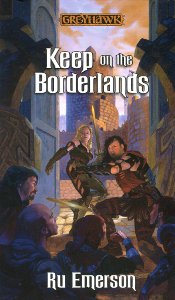
Review: Keep on the Borderlands

Caution: Spoilers (both of the novel and the module on which it is based)

Next on our list of Greyhawk novels from the early 2000's is Ru Emerson's second title in the series; Keep on the Borderlands. I wasn't a huge fan of her first effort, but was determined to give this one a fair shake. Unfortunately, it's only marginally better than Against the Giants, and suffers from a unique problem as well.

As with the rest of the books in this series, the novel attempts to bring to life the classic D&D module Keep on the Borderlands. Beloved by many (indeed, many players name KotB as their favorite module of all time), the module has players exploring a system of caves stocked with various sorts of humanoids and other perils, very suitable for first-level adventurers, who return to the eponymous Keep to rest, heal, and restock their supplies.

The first half of the novel, on the other hand, is spent fighting bandits (two different bands of bandits? Three? The book is unclear), presumably merely to introduce the character of Blot (later renamed Flerys in a seeming attempt to deliberately confuse the reader), a young girl who had been living with the main group of bandits. The raids into the Caves of Chaos themselves seem almost perfunctory, taking a couple of pages to wipe out each band of humanoids, and then dispatching the priest of Chaos in similarly short order. The pacing is terrible, hearkening back to the earlier book.

That brings up one of the problems with the novel; we don't find out until almost the end that there was, apparently, a steady stream of chaos cultists passing by the Keep on their way to the caves. It's only mentioned in passing, just as the characters are heading into the final cave wherein lies... the temple of chaos. Despite the fact that this is actually highlighted on the back cover blurb of the book, it seems thrown in as an afterthought, when, if it had been mentioned earlier on, might have provided some much-needed narrative glue to hold the thing together. The ending, such as it is, comes abruptly and without any sort of fanfare. Ho-hum, the cleric we haven't seen for the first two-thirds of the novel casts a spell and kills the evil cleric. Done.

The characters are slightly better defined than in Against the Giants. Eddis and M'Baddah seem interesting enough that I wouldn't mind reading more about them, but the remainder of the party (including Emerson's seemingly favorite trope, the mysterious twins with the special bond, just as we saw in the first novel) is pretty forgettable. What makes it worse is that it's painfully obvious that the author is trying to make the rest of the characters stand out, but failing in the attempt.

Perhaps the biggest flaw in this addition to the line of Greyhawk novels is that it isn't a Greyhawk novel at all. Although it has the Greyhawk logo on the cover, there is absolutely nothing to tie the novel to the setting. It is as completely generic as the original module, and while that is one of the module's strengths, it leaves a bad taste in the mouth of a Greyhawk fan looking for material to use in an RPG campaign based on the promise that the novel actually takes place there.

On the whole, a dull read with the same sort of pacing problems that plagued its predecessor, that adds nothing to the Greyhawk milieu. Completest fans of the original module may get something out of it, but it'll take some doing.

I rate it two wizards out of five.

Saturday, March 16, 2013

Review: Queen of the Demonweb Pits

Caution: Spoilers (both of the novel and the module it's based on)

We come now to the final volume of Paul Kidd's Greyhawk trilogy, following up on White Plume Mountain and Descent into the Depths of the Earth; Queen of the Demonweb Pits. Published in 2001, this novel is a direct follow-up to the previous one, taking place almost immediately after the events of Descent into the Depths of the Earth.

Set in CY 583, we are back with the faerie princess Escalla, the brooding ranger the Justicar, Enid the sphinx, Cinders the sentient hell hound pelt, Polk (now a badger, having been reincarnated by a druid), talking magic sword Benelux, and Henry, a young warrior that the group picked up on their adventures.

The plot revolves around the demon queen Lolth's desire for revenge following her reversal in the Vault of the Drow in the previous adventure. Following his previous pattern, Kidd doesn't provide us with a recital of how a group of PCs might approach the published module; rather, he uses the module as the basis for an entirely new plot, demonstrating yet again the versatility of the old "location based" modules for a game master with imagination. We see the giant steam-driven spider-palace and the titular Demonweb Pits itself, but now in the context of Lolth's invasion of the Flanaess as she gates in a demonic army to sweep through Furyondy.

While the army is ravaging the countryside, our heroes travel to the Abyss to confront and ultimately defeat Lolth on her home ground, while at the same time both Escalla and the Justicar are tracked by a pair of enemies with grudges, brought into the action by Lolth specifically to enact her revenge. Needless to say, the second-stringers are dealt with and Lolth herself is eventually destroyed by falling into a portable hole filled with holy water. All is well, and the Justicar and Escalla are wed, but not after freeing Enid from the afterlife (!) which involves a confrontation with the Egyptian God Thoth (!!).

I've got to say that, although this book was very well done, I simply didn't enjoy it as much as I did the previous two. The sharp edged repartee between the Justicar and Escalla was missing, now that their romance has blossomed, and the change in the dynamics within the group was definitely felt. The novel feels a bit... softer... than the other two. This feeling is not helped by the fact that Lolth, as presented here, seems almost ditzy, and only her indentured handmaiden Morag (a Type V Demon) seems able to keep her focused on anything. (The "overly efficient and lawful demon assistant" is a character that also comes up in Gygax's Gord the Rogue books, as we shall see, in the character of Vuron.)

The final chapter, in which the characters actually infiltrate the afterlife and make a fool out of the God Thoth, seems tacked on, especially since it hand-waves an apparently arduous adventure among the outer planes to find the water from the river Mnemos to restore Enid's memory after being in the river Lethe. Why both with this, when a simple raise dead spell could solve the problem? It feels like Kidd was told to pad out the book so it went past 300 pages.

This book also creates some canon issues. Lolth is dead as of CY 583? There was a major demonic invasion in Furyondy and nobody seems to have noticed? The best sorts of novels are ones that don't describe enormous changes in the setting, especially changes which are contradicted (or not corroborated) by other sources.

Despite my enthusiasm for Kidd as a writer, and for these characters specifically, these faults must bring down my rating for this particular outing, which is unfortunate. I give it three wizards out of five.

Wednesday, March 6, 2013

Review: The Temple of Elemental Evil

Caution: Spoilers (both of the novel and the modules it's based on).

Today's bit of Greyhawkiana is the novel The Temple of Elemental Evil, by Thomas M. Reid. Mr. Reid is probably much better known for his novels set in the Forgotten Realms, but this novel, published in 2001, is his first written for TSR before he moved on to the FR.

This novel hews pretty closely to the original classic adventure module written by Gary Gygax and Frank Mentzer and published by TSR. A party of adventurers is summoned to the village of Hommlet by the powers-that-be to explore the happenings at the supposedly-abandoned nearby Elemental Temple. The village is attacked by brigands before the expedition can begin, but they soon make their way to the Moat House. I thought that their being attacked by the famous giant frogs near the entrance to the Moat House was a nice touch, and the use of some Temple spies first encountered in Hommlet, who then later pose as fellow explorers of the Moat House was pretty well done.

Lareth, I thought, was under-utilized. Having failed to keep the Moat House safe from the intruders, he hies himself back to the Temple, only to be tortured and maimed by the high priest thereof, Hedrack. Now no longer "the beautiful", Lareth is sent to destroy the intruders with an army of humanoids and a giant, but is himself slain and somehow rises as a shadowy spider-like apparition. Reid takes the casual mention of a connection between Lareth and the demonness Lolth and runs with it, building a whole sub-plot of machinations between Iuz/Zuggtmoy and Lolth, which I found somewhat unnecessary. In the end, Elmo is dead, Zuggtmoy left imprisoned, the Temple itself leveled, and Prince Thrommel freed and off to Chendl to marry the fair Jolene.

I found this book to be... workmanlike. The writing was decent, the characters presented well enough that I could differentiate them from one another (unlike Against the Giants on both counts), but the whole seemed rather a bit lacking in verve. I would have liked to see a lot more of the iconic NPCs from the module; we get our share of Elmo, but Burne and Rufus are on the sidelines, Jaroo is mentioned but never seen, Otis and Y'Dey are absent, etc. Too, I find it difficult to place this novel in the context of Greyhawk canon; the events vis-a-vis the Temple are fairly straightforward, but the very end of the novel mentions a brewing civil war in Veluna that I don't recall happening in other sources.

There's not a lot here that can be added to a campaign; aside from the adventurers themselves, there are no new NPCs of note, no background or plot to pillage for a campaign, and no new ways to utilize the existing module (unlike what we saw with White Plume Mountain or Descent into the Depths of the Earth). Still, it gives a good idea of what a "typical" campaign focused on the Temple would look like, so in that respect it would be a good read for a DM planning on running such a campaign.

I give it three wizards out of five.

Tuesday, February 26, 2013

Review: Descent into the Depths of the Earth

Caution: Spoilers (both of the novel and the modules it's based on).

Today's foray into somewhat obscure Greyhawkiana is a direct sequel to the last post in the series. Paul Kidd's Descent into the Depths of the Earth is the second in his trilogy of novels set in Greyhawk featuring the Justicar and his companions. Published in 2000, the novel picks up only a few weeks or so after the previous novel, White Plume Mountain, ends.

In this novel, Kidd takes the same approach with the original source material (the adventure modules D1-D3; Descent into the Depths of the Earth, Shrine of the Kuo-Toa, and Vault of the Drow) and uses them as the backdrop against which he tells an original story. I find this a terrific way to showcase the versatility of the adventure modules themselves, demonstrating that they don't only have to be used as the follow-up to the Giants novels, and that adventurers can have all sorts of motives for hitting the tunnels and caverns of Oerth's underdark.

In this case, the Justicar, his sentient hell hound pelt Cinders, faerie Escalla and Polk the drover have a double mission. First, to clear the name of Escalla, who is suspected of murdering a faerie prince she was to marry (against her will) and also to track down and rescue a village full of innocents who have been captured in a raid and taken underground. The two plots interweave nicely, and the mystery of who is behind the murder/frame-up is handled well.

The novel has more depth to it (pardon the pun). Where the first in the series was more light-hearted and sacrificed some complexity in the name of introducing the characters and establishing their relationships, this novel is definitely more layered in its narrative. There's a lot going on, between the politics of the Seelie Court, the various plots that involve the drow and their demon queen, and the budding romantic relationship between the Justicar and Escalla, and Kidd handles it all adroitly.

That's not to say there's not humor, which is one of the things I like most about his books in this series. For fans of the Greyhawk setting itself, there's a lot of new material that can be directly adapted for one's own campaign with the Seelie Court and its various clans and factions, and the description of the party's movements through the underdark is a model of how a group of player characters should approach the place.

This is quite an enjoyable read and I'd recommend it to anyone, especially if they enjoyed White Plume Mountain. I find myself very much looking forward to the final book in the Justicar trilogy.

I give it four wizards out of five.

Saturday, February 16, 2013

Review: Against the Giants

Caution: Spoilers (both of the novel and the modules it's based on).

I thought I'd take a tour through some of the lesser-known works of Greyhawkiana, starting with some of the Greyhawk Classics novels of the late 1990's and early 2000's. The first I'm going to cover is Against the Giants by Ru Emerson, published in 1999. The novel was originally released in conjunction with the compilation module Against the Giants, which itself was a compilation of modules Steading of the Hill Giant Chief, Glacial Rift of the Frost Giant Jarl, and Hall of the Fire Giant King, with additional material.

The novel itself cleaves very closely to the plot of the original Giants modules. Hill giants are ravaging villages in western Keoland and southern Sterich, and a band of brave adventurers is sent off to stop them and discover what is behind the raids. It takes place in CY 585.

There are several problems with the novel, both from a Greyhawkian perspective and a literary one. First and foremost, the characters are completely forgettable. There's a paladin, a barbarian, a fighter, a magic-user, and a pair of half-elven rangers, but at times it was very difficult to figure out which character was talking, because there was almost nothing to distinguish them. The only halfway-interesting character in the party is killed almost right off the bat, but his death has no discernible impact on the others. The stock "awed farm boy who was trained by his warrior father and survived the massacre of his home village" seems unchanged by his adventures.

The plot lingers on the first of the three giant strongholds, where various prisoners are released, some of whom join the party. However, the attention given to the Steading seems to come at the expense of the other two, as almost no time is spent on the frost giant stronghold, and the foray into the fire giant hall is rushed to the point of feeling almost perfunctory. In fact, the characters even go out of their way to say that the glacial rift of the frost giants is only a means to get to the real destination; the fire giants' hall.

One big reason for the unseemly haste is the fact that the party's mage conveniently was a slave of Eclavdra (the drow ultimately behind the raids) and knows the layout of both the rift and the fire giants' hall. If he had been selected for the mission because of his knowledge, it might not be so bad (although still way too convenient), but the fact that it seems to come as much of a surprise to him to see Eclavdra's signature on a scroll strains one's credulity. He knows of the teleporting devices that allow quick movement between the strongholds, and becomes the deus ex machina for any knowledge the party needs to hasten along to the end of the book.

A bigger problem structurally lies with the fact that the novel ends with the destruction of the drow priestess Eclavdra (in a very blasé presentation that compares poorly with the ones we will see in other places) and a couple of her henchmen. There is no final confrontation in the drow city, just a quick and easy death for the villain and voila! Mission accomplished. This obviously raises some canon problems; not her death, which is actually dealt with as a possibility in the adventure modules, but the fact that there isn't anything beyond the single drow priestess pulling King Snurre's strings.

On the whole this is a very forgettable book. Other than adding a few place-names and possible NPCs (none of whom seem particularly compelling), it reads like an account of a game run through the modules that featured a player who had already read them and knew exactly where to go.

I rate it two wizards out of five.

Sunday, October 28, 2012

13 Days of Halloween: Day Ten

Today I thought I'd give a quick run-down on real-world occult books that an enterprising game master might find of use when putting a game together. Whether you want to make your demonology in a fantasy game more true-to-life, or need some background for Call of Cthulhu, hopefully you'll find these of interest. All are still in print or available as free electronic editions somewhere online.

The Key of Solomon the King (aka "Clavicula Salomonis"). There are a bunch of translations out there, but this is one of the basic texts on summoning and controlling demons and angels.

The Lesser Key of Solomon (aka "The Goetia"). Along the same lines as the Key of Solomon above, but this one is actually a different book. This is the one that has the 72 Goetic demons, along with their various seals. Alistair Crowley did his own edited translation of this book, which was quite different from the original text (some say it's much more practical in terms of application).

The Black Pullet. Another early-modern grimoire, covering much the same material of the two Keys of Solomon, but with it's own details and symbols. Personally, I think this is one of the best names for a book of magic ever.

Futhark, A Handbook of Rune Magic by Edred Thorsson. This was one of the first books to popularize the runes within the pagan and occult communities, and remains one of the best in terms of the quality of the scholarship (the author holds a PhD in Germanic Languages and Medieval Studies) and accessibility. It covers all of the historically-known runic alphabets (there are more than just one) and describes magical uses for the runes including divination, magic, etc. If you get one book on runes, make it this one.

The Black Books of Elverum. This is a nicely different pair of magical books; two grimoires from Norway. The book gives hundreds of charms and spells to find stolen objects, get a lover, etc. etc.

The Magician's Companion by Bill Whitcomb. A pretty comprehensive encyclopedia of everything to do with ritual magic, broken up into a number of different magical models; 4 elements, 7 planets, 28 lunar mansions, etc. An excellent source-book that you can just open up at random and find inspiration.

The Anglo-Saxon Metrical Charms. Want to know what folk-charms and spells look like? Go to the source.  Here you'll find what the ancient Anglo-Saxons did to cure various diseases, find lost cattle, etc. 

Thursday, May 24, 2012

102 Places for Free Sci-Fi and Fantasy Books Online

While you're waiting for the Wizards of the Coast servers to recover from their self-inflicted DoS attack, you might want to peruse this list of 102 places for free science fiction and fantasy books online. And they're all legal, apparently. Wowzers!

Monday, December 12, 2011

Book Review: The Ancient Blades Trilogy

Back in late July, I received a copy of the first book in a new series of fantasy novels called the Ancient Blades Trilogy (which I reviewed here). The author was kind enough to send me the next two books in the series as well, and I just finished the last one today. The author, David Chandler, is a member of the New York Red Box campaign in NYC. It helped that at the time I was looking for a new fantasy series to start, and Chandler's trilogy fit the bill.

The books deal with a petty thief, Malden, who is befriended by a knight, Sir Croy, and the daughter of a witch, Cythera. The first book, Den of Thieves, takes place completely in the free city of Ness, which is a typical but well-rendered fantasy city a la Lankhmar or Greyhawk. There he becomes embroiled in the politics of the city and sinister goings-on that threaten to tear the place apart, both literally and figuratively.

I don't want to give away much of the plot, but the books become progressively more expansive as the trilogy moves on, introducing more characters and showing us more of the fantasy world. The next book, A Thief in the Night, takes the heroes across the kingdom of Skrae and into the bowels of a supposedly-abandoned dwarven city which holds a great secret (or three). The final book, Honor Among Thieves, is the largest in scope, as the kingdom of Skrae finds itself at war, and Malden and Croy are at the forefront of the action.

Although Malden, the central character, certainly changes in terms of his situation and station as the books progress, there isn't really a lot of changes to him as a character; he maintains his central core throughout the action that swirls around him, and the final book ends on a note that suggests we will be seeing more of him and this world in the future.

This isn't Tolkien by any stretch of the imagination, but all three books are a fun read. I found myself actively looking forward to picking up the book and continuing; the chapters are numerous and very short (3-5 pages each), which makes reading them in short bursts very easy to do. Chandler's familiarity with the tropes of fantasy novels and role-playing show through, but not in such a way that the books read like a novelization of someone's campaign.

You can find all three books of the Ancient Blades Trilogy on Amazon.com or at your local bookstore. I give them three and a half stars out of five.