Showing posts with label Dune. Show all posts

Monday, November 3, 2014

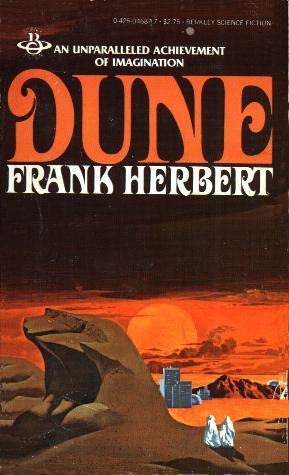
Dune: The Television Series

It's no secret that big-budget shows, with a shortened (10 episode or so) season, are all the rage right now. Of course the trend is exemplified by Game of Thrones, but we've seen it in other historical dramas like Rome, The Tudors, and The Borgias, and with more sci-fi/fantasy/horror fare such as The Walking Dead and American Horror Show. SyFy just announced that not only are they doing Childhood's End as a miniseries, but 3001: The Final Odyssey is also coming to the small screen. Plus American Gods. Plus a bunch of others.

I submit that there's a series of novels that would make every bit as compelling a series as Game of Thrones.  Frank Herbert's Dune novels.

I'm not talking about the prequel novels by his son (which are pretty awful; some might go even further in their... dislike of them), but the original novels. Dune (1965), Dune Messiah (1969), Children of Dune (1976), and God Emperor of Dune (1981). I omit Heretics of Dune (1984) and Chapterhouse: Dune (1985) which pretty much take the series in a completely different direction. The first four books (many would argue - with some justification - that the first three books are sufficiently self-contained to not need the fourth, but I disagree for a variety of reasons).

The comparisons with Game of Thrones are stunning, but I submit Dune has an even grander scope (the entire universe, and spans 3,500 years if you include God Emperor), deals with questions of history, civilization, religion, the nature of time and prophecy, ecology and the economics of scarcity, and more. Yet it is also firmly grounded in the interrelationships between, and growth of, the characters; at its heart it is the story of a family doomed to become those things they hate the most.

The political maneuvering is as intricate as anything you'll see in King's Landing. It begins with the feud between the noble houses of Atreides and Harkonnen, fueled by the desire of the Padishah Emperor to remove Duke Leto Atreides as a rival for power. But there are layers upon layers of complexity as new centers of power are revealed - the Bene Gesserit sisterhood, the Fremen, the Spacing Guild, the Bene Tleilaxu, and later Fremen factions and renegades, a new Priesthood of Muad'dib, the deposed (formerly Imperial) House Corrino, and much more besides. Plus there are factions within factions and individuals shift from one to another. Fans of that sort of intricate plotting would be in hog heaven.

There are also a lot of opportunities for violence and war. One of the conceits of the novels is the artificial constraints on technology. Thinking machines are outlawed, and bladed weapons are back in vogue because of the adoption of personal shields that block conventional bullets and which blow up in contact with a laser. So combat is much more personal, hearkening back to something you might see in a more medieval-esque setting (ahem). There are wars, battles large and small, duels, gladiatorial combats, assassinations, and more.

There's relatively little sex or nudity to be had, but the opportunities are certainly there (just as the writers for GoT managed to insert quite a bit where I don't remember reading about it in the novels). Paul and Chani, Alia and various people, Feyd-Rautha, and others. It could certainly be included if that was deemed a requirement. (Personally I don't think it would be, but I can't speak for everyone, let along for what a network would want to see.)

Now, it is true that Dune has already been tackled twice on the screen. Once as David Lynch's famous flop, and again by the SciFi channel as a pair of three-part series. Personally I like them both, although both have enormous flaws. The visuals in the Lynch version were great (with some notable exceptions like the disease-scarred Baron Harkonnen), but Sci-Fi cleaved closer to the novels in terms of plot and took a lot more time to develop the relationship between the Atreides and the Fremen. Both versions had their good and bad casting choices, but the Sci-Fi version was limited in terms of budget and it shows in a lot of scenes.

I foresee a series that goes at least four seasons, possibly five. You could at least two seasons out of the first book, possibly three. It could be broken up in two ways:

  1. Arrival of the Atreides on Arrakis through the destruction of the Atreides by the Emperor/Harkonens.
  2. Atreides merge with the Fremen through the Fremen attack on the Emperor and start of the Great Jihad.
Or:

  1. Arrival of the Atreides on Arrakis through the destruction of the Atreides by the Emperor/Harkonens.
  2. Atreides merge with the Fremen through about the middle of the Fremen war against the Harkonnens. Includes lots of scenes of the war that are glossed over in the book.
  3. Finish the Fremen war against the Harkonnens through the Fremen attack on the Emperor and start of the Great Jihad.
The remaining books would each be good for a season. So there's a five, maybe six season show, with no chance that the show will overtake the books. If they managed to maintain a level of quality similar to GoT or Vikings, you couldn't tear me away from the television.

Wednesday, March 2, 2011

Goodnight, Dune

I'm a huge fan of Frank Herbert's Dune (not so much a fan of the books that his son has churned out in the years after his death, although perhaps not quite so much a non-fan as some people), both the books and both film adaptations. My wife was kind enough to share the following with me (a parody of the children's classic "Goodnight Moon"), and I thought it so clever that I'd share it with you, too. Click the image to see the whole thing. If you look at the images closely, there's a lot tucked away there that doesn't get it's own "goodnight." Great stuff.

Sunday, October 17, 2010

Games I Love: Dune (Avalon Hill)

When I was in high school, Avalon Hill's "Dune" was one of our standard go-to wargames. We must've played it a hundred times, and one of the best things about it was that it never got old. In fact, I played the game before I had read the books, and I credit it with getting me to read one of the finest works of science fiction ever written.

There are six factions competing for control of the planet Dune; the Emperor, House Harkonnen, House Atreides, The Guild, the Bene Gesserit, and the Fremen. There are a certain number of cities on the board, and capture of either three or four (depending if you are attempting to win singly or as part of an alliance with another player) signals the end of the game. There are a limited number of troops that each faction can deploy, and combat is handled with a combination of troops sacrificed, leaders used, and spice (money) spent. Cards can be played in both combat and other situations, which gives a nice randomness to the flow of the game, but one which is mitigated by some of the special powers each faction possesses. Spice (money) appears randomly in certain spots on the board, and some factions are in a better position to collect it, either by virtue of their special powers, or by which cities they hold.

Those special powers are what make the game so eminently playable. It is absolutely perfectly balanced, even though the different factions have what seem to be wildly differing powers. The Emperor gets the money bid on cards by the other players, and has access to his Sardaukar troops, which are special units worth double in combat. He has the disadvantage of not starting the game with any troops on the board, however, and it is possible for the other players to cooperate to thwart his money-making abilities, by not bidding high amounts of spice for the cards. The Harkonnens can hold double the number of cards, can have a high number of other players' leaders as their own traitors, and start with one of the key cities on the planet. And so forth. Each faction has powers specific to itself, as well as powers that can be used only when they are allied to another player-- for instance, if you're allied to the Harkonnen, all their traitors can win battles for you, too.

Perhaps the most devastating power is the Bene Gesserit's ability to predict the winner. By clever and subtle play, they can manipulate the player of their choice to win on a particular turn. If they predict successfully, they win instead! I've seen it happen more than once, and it's devastating when you're the one they've predicted.

It's exquisite balance makes this a timeless classic that has unfortunately been lost in the spate of recent games. It's unfortunately out of print, and a quick check of eBay shows that copies are in around the $100+ range. If you've got a regular stable of friends who play board games, however, I'd say it was worth it, regardless of whether you get the original cover or the later one with Sting (who played Feyd Rautha in the David Lynch film). Forget the two expansions, however; The Duel and Spice Harvest. They add nothing but a few new cards that do not, in and of themselves, really add anything necessary to the game.

In the course of preparing this post, I did stumble across this web site, which might be of interest to those looking to see the details about the game, with images of the cards and other pieces, a copy of the rules, the board, etc. Ahem.

There is, however, an issue of The General with alternate rules for a seventh faction; the Bene Tleilaxu. I've played with those, and they work really well, with the BT being very well balanced in the tradition of the original. You'll also find that on Colin's Dune Page, linked above.